The Cold Clarity Problem: What Chill-Filtration Costs — and Who Refuses to Pay It

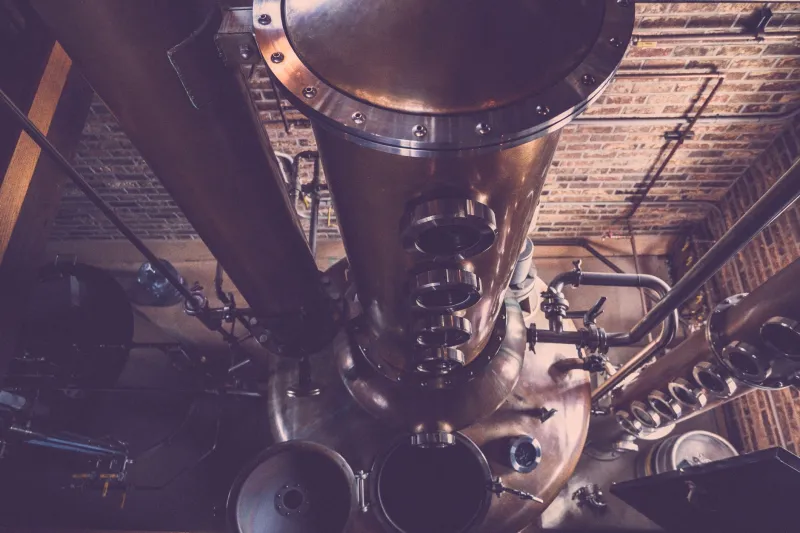
Photo: whisky glass condensation cold distillery filter stock photo, via www.tastingtable.com
Chill-filtration is one of those production details that sounds dull until you taste the difference. It is also one of the few technical choices a drinker can actually spot on a back label — if they know what they are looking for. In simple terms, the spirit is chilled to around 0°C, sometimes a little lower, and passed through a filter. The cold makes certain fatty acids and long-chain esters clump together; the filter catches them. What comes out is a bottle that stays crystal clear when you add ice, water or a winter window ledge.
That is the sales pitch. The counter-pitch is that clarity has a cost. Those same compounds can contribute oiliness, weight and aromatic depth. Strip too much and a whisky or rum can feel thinner, cleaner and more polite than it ought to. Not every filtered spirit is ruined — far from it — but the process is a choice, not a law of nature. And in the UK, where 40% ABV is still the volume zone in supermarkets and many bars, that choice matters more than drinkers might think.
What chill-filtration actually does
A chill-filter is not a flavour extractor in the way a still is. It is a stabiliser. Distillers use it to prevent haze forming at low temperatures or when water is added. For a brand that needs every bottle to look identical on a shelf in Aberdeen in January and in a Brighton bar in July, that consistency has real value. Clear spirit also avoids the customer-service email nobody wants: the one asking why their £40 bottle has gone cloudy overnight.
The process can remove some heavier fatty acid esters and proteins. Those are not the whole flavour of a spirit, but they can be part of its texture. A chill-filtered whisky at 40% can taste perfectly good — rounded, clean, easy — while a non-chill-filtered version at 46% may feel oilier and carry more aroma into the finish. The difference is usually one of mouthfeel and nuance rather than night-and-day flavour. Anyone who tells you chill-filtration always destroys a spirit is overstating it. Anyone who says it never changes anything is doing the same.
The strength question
Here is where UK drinkers come in. Chill-filtration becomes more necessary at lower strengths. At 40% ABV, there is more water in the bottle and those haze-forming compounds are more likely to fall out of solution when chilled. At 46% or cask strength, the spirit is more stable and many distillers skip the filter entirely. That is why the quiet move towards 46% in craft spirits has gone hand in hand with the rise of non-chill-filtered bottlings. It is not just about a few extra points of alcohol; it is about keeping the spirit in a state where it does not need cosmetic help.
This is also why the label can be a useful clue without being a guarantee. A 40% bottling is more likely to be chill-filtered. A 46% bottling is more likely not to be. But likelihood is not certainty, and some distillers filter at 46% because they want a particular polished house style. The only reliable answer is on the back label or the distillery’s own notes.
A small, unscientific comparison
I poured two Speyside-style malts side by side, not blind because I wanted to read the labels as I went. Bottle A was a 40% chill-filtered blend; Bottle B was a 46% non-chill-filtered single malt. Different liquids, so this is an illustration rather than proof.
Bottle A looked immaculate, even after a few minutes in a chilled glass. On the nose it was barley sugar, soft orchard fruit and a faint cereal sweetness. The palate was rounded and slippery, with a finish that cleaned up quickly. Pleasant, composed, slightly buttoned-up. Bottle B, given the same treatment, threw a faint haze when I added a splash of water. The nose had more oil and pear skin; the palate felt chewier, with a longer, warmer finish. It was not automatically better, just more present. If you drink your whisky with ice or a lot of water, Bottle A’s clarity is a genuine convenience. If you drink it neat and want texture, Bottle B makes a stronger case.
How to spot it on a label
Start with the obvious: bottles that say ‘chill filtered’ or ‘non-chill filtered’ are doing you a favour. ‘Unfiltered’ is less precise — it may mean no filtration at all, or no chill-filtration — so treat it as a prompt to ask rather than a firm answer. ‘Natural colour’ tells you nothing about filtration. Neither does ‘small batch’. ABV is a clue: 46% and above is often non-chill-filtered, while 40% is often filtered, but neither is a rule. Look for phrases like ‘bottled without chill-filtration’ or ‘may haze when chilled’. A distiller who warns you about haze is usually being straight with you.
Three distillers, two positions
Rhona Mackie, head distiller at Braeside Distillery, is pro-filter for her core range. ‘We chill-filter our 40% house malt because we want it to look the same on a supermarket shelf in Aberdeen in January and in a bar in Bristol in July,’ she says. ‘At that strength, a little haze is almost inevitable. We use a light filtration, not a strip. The aim is stability, not sterility.’ She argues that clarity is part of the product for a broad audience, and that drinkers who want the fuller texture can trade up to the distillery’s 46% bottling, which is not filtered.
Tomos Llewellyn at Cwm Celyn Distillery takes the other view. ‘At 46%, our whisky does not need it,’ he says. ‘We tried chill-filtration early on and it took the oiliness out. It was still good whisky, but it was less ours. We put a note on the back: may cloud with water. Drinkers understand. Nobody has ever sent a bottle back because it went a bit cloudy in the fridge.’ For Tomos, haze is a fair trade for mouthfeel — and a useful signal that the spirit has not been over-managed.
Priya Shah at Saltmarsh Distillery sits in the middle. ‘We chill-filter our 40% flagship and leave the cask strength unfiltered,’ she says. ‘It is not a religion. It is a decision about strength, shelf life and what the liquid can carry. At cask strength, filtration would be cosmetic. At 40%, it is sometimes practical.’ That pragmatism may be the most common position in UK craft distilling: filter when the strength demands it, skip it when it does not, and tell drinkers what you have done.
The takeaway
Chill-filtration is not the villain of craft spirits, and clarity is not a sin. But it is worth asking what a bottle has given up to look neat. If you drink at 40% and like a polished, consistent dram, filtered spirits can be exactly right. If you want oil, weight and a little winter haze, look for 46%, non-chill-filtered, and a back label that tells the truth. The best distillers are not hiding the choice. They are defending it.