Barrel Dressing: How to Spot a Cask Finish That Adds Depth — Not Just a Famous Name
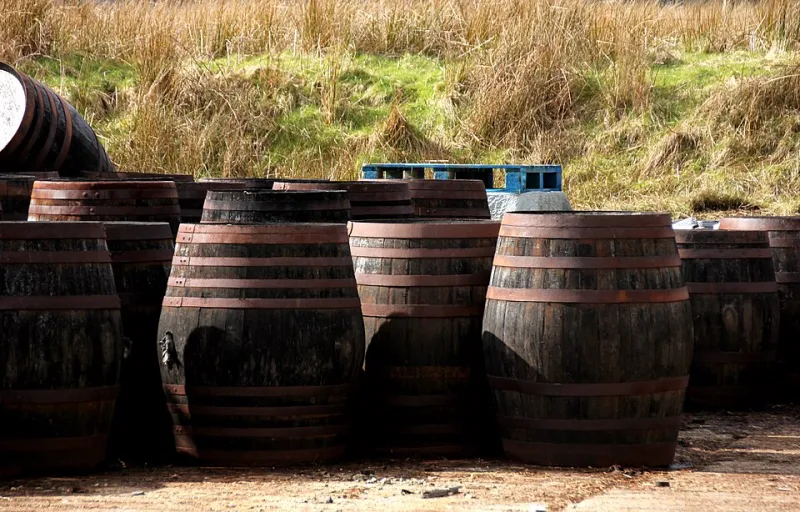
Photo: Bjarne Henning Kvaal…, CC BY-SA 3.0, via Wikimedia Commons
The label says 'finish'. What does that mean?
Cask finishing is secondary maturation. The spirit has already spent time in one cask — or in a tank, in the case of some gins — and then goes into another vessel for a final stretch. The idea is that the second cask adds something the first could not: dried fruit from a sherry butt, red fruit from a port pipe, smoke from a peated cask, softness from an ex-cognac barrel.
It is not a new idea. But in UK craft spirits, the word 'finish' has become a marketing tool as much as a production step. Walk into any good bottle shop in 2026 and you will find rum finished in Islay casks, English whisky finished in Sauternes barriques, and gin rested in ex-sherry butts. Some of it is excellent. Some of it is wallpaper.
What a finish can — and can't — do
A finish works on three levels: extraction, oxygen and time. The spirit pulls flavour from the wood and from whatever was in the cask before. Oxygen slowly changes the spirit. Time lets the two settle together. Get those three right and a finish can add texture, length and a new layer of aroma without burying the base spirit.
Get them wrong and you get a spirit that tastes like it is wearing a coat that does not fit. 'A finish is a seasoning, not a rescue,' says the head distiller at a Yorkshire whisky distillery. 'If the spirit is thin after three years, six months in a PX cask will make it sweet and sticky. It will not make it complex.'
That is the first thing to understand. A finish cannot fix a bad base spirit. It can only amplify what is already there — or hide it.
Three spirits, three sets of rules
Whisky is the obvious one. In the UK, a finish usually comes after the main maturation period, and the best examples give the spirit a clear extra dimension: a dry oloroso finish that adds walnut and orange peel, or an ex-rum cask that brings tropical fruit and a rounder texture. The worst examples taste like the base whisky has been dipped in a flavour and rushed out the door.
Rum has a different logic. Many UK craft rum brands buy aged rum from the Caribbean and finish it here. That can work beautifully — an ex-port finish on a nicely aged rum is one of the great simple pleasures — but it can also be a way to dress up young, neutral spirit. If the rum tastes thin under the finish, the finish is doing too much work.
Gin is the wildcard. Cask-rested gin can be lovely: soft, golden, with a whisper of vanilla and wood. But gin botanicals are delicate, and a heavy finish can turn a bright London dry into a confused liqueur. 'We tried a peated cask finish on gin once,' says a distiller in Kent. 'It tasted like a campfire that had been to a perfume counter. We did not bottle it.'
Shortcuts and gimmicks to watch for
A finish with no time on the label is the first warning sign. 'Cask-finished' can mean six months or six weeks. The second is a famous cask name on a young spirit. PX, oloroso and Sauternes are all wonderful, but they are also good at making a young spirit taste sweeter and more expensive than it is.
Then there is the small-cask trick. Small casks extract faster, which is useful if you want to turn a spirit around quickly. It is less useful if you want a finish that feels integrated. 'We see bottles finished for six weeks in a wet PX cask and called a finish,' says a rum blender in Bristol. 'That is seasoning a chip, not maturing a spirit.'
Finally, watch for sweetness doing the work of complexity. A finish that adds sugar and little else is not adding depth. It is adding pudding.
How to taste a finish properly
Start with the nose. Does the finish dominate, or does it sit alongside the base spirit? If you can only smell the cask — all dried fruit, all smoke, all vanilla — the finish is probably masking something.
On the palate, look for integration. A good finish feels glued together. The texture should change, not just the flavour. Add a splash of water. If the finish falls apart and the spirit goes thin, it was never doing much.
Finally, check the length. A finish should make the spirit longer, not just sweeter. If the flavour disappears after five seconds, you are tasting a coat, not a character.
Six finishes worth trying
- Ex-oloroso sherry finish on English single malt — dry, nutty and savoury when it is done well, not just sweet.
- Ex-rum cask finish on Scotch — tropical fruit and a rounder texture, especially on a coastal malt.
- Ex-port finish on aged rum — red fruit, soft tannin and a long finish. A classic for a reason.
- Ex-Sauternes finish on gin — honeyed and golden, but only if the juniper still speaks.
- Ex-peated cask finish on rum — smoke as a seasoning, not a smokescreen.
- Ex-cognac finish on rum — grape, softness and a gentle woody edge. Quietly excellent.
A distiller's checklist for judging a finish
Ask these questions before you spend £40 or more on a finished bottle:
- Is there an un-finished version to compare it with?
- Does the label tell you how long the finish lasted?
- Is the base spirit old enough to stand on its own?
- Does the finish add texture, or just flavour?
- Is the sweetness balanced by acidity or bitterness?
- Can you still taste the spirit under the cask?
- Does the finish last longer than the swallow?
If the answer to most of those is yes, the finish is probably doing its job. If the answer is no, you are buying a barrel name.
The bottom line
Cask finishing is one of the most useful tools in a craft distiller's kit. It is also one of the easiest to abuse. The next time you see a bottle shouting about a famous cask, look past the name. Ask what went in, how long it stayed, and whether the spirit underneath is worth finishing at all. A good finish adds complexity. A bad one just adds a story.